
What is ALF?
The Advanced Learning Fund (ALF) is designed to support faculty and teaching staff in designing and implementing innovative approaches that enhance student learning. This funding scheme aims to cultivate a forward-thinking educational environment at HKUST by encouraging the adoption of pedagogies that promote deeper understanding, critical thinking, and sustained student engagement.
Overview of the Advanced Learning Fund, including its purpose, priorities, and criteria for developing a strong proposal (Require HKUST login)
The primary objectives of the Advanced Learning Fund include:
The fund supports projects that explore innovative learning pathways for student success, with a strong emphasis on approaches intentionally designed and integrated within courses to achieve intended learning outcomes.
It encourages the use of active learning strategies that foster deeper understanding, critical thinking, and sustained student engagement.
For AI in Education initiatives, a key objective is the strategic and ethical integration of Artificial Intelligence into educational environments to simultaneously enhance student learning outcomes and boost students' competency in AI and digital literacy.
Specifically, in the context of AI in Education, the fund aims to leverage AI as a cognitive partner to cultivate essential human skills like metacognition, creativity, and critical thinking, thereby fostering a holistic and future-ready approach to teaching and learning
The fund supports initiatives that promote curriculum design innovation, create hyper-personalized and adaptive learning pathways, develop sophisticated assessment methods, and provide real-time, actionable insights into student progress.
By supporting various initiatives, the ALF seeks to improve teaching methods, student engagement, and the overall educational experience within the formal undergraduate curriculum.
Key Themes
The Advanced Learning Fund covers a wide array of teaching and learning initiatives, under 4 themes, namely, Pedagogical Innovation, Emerging Technology, Global Outreach and Student Partnership.
1. Pedagogical Innovation
This theme consists of below initiatives, covering:
Blended Learning (BL) at HKUST is defined as a blend of online and face-to-face teaching aimed at enhancing student learning. Typically, students acquire fundamental, conceptual knowledge online and then apply, analyze, or evaluate this through active learning classroom activities to achieve higher-level learning outcomes. The development of BL courses is recommended to replace 30-50% of contact hours with the online component for self-study and keep the remaining 50-70% of contact hours for course instructors’ face-to-face teaching.
Experiential Learning is an educational approach that emphasizes learning through experience and reflection. Grounded in the idea that students learn most effectively when actively engaged in authentic experiences, this approach enables them to apply knowledge, develop practical skills, and connect theory with practice. Experiential learning may take many forms, including project-based activities, community engagement, fieldwork, internships, simulations, and other real-world learning experiences. Through intentional reflection on these experiences, students deepen their understanding, critically examine their assumptions, integrate new knowledge, and develop professional and transferable skills, leading to more meaningful and lasting learning.
Gamification and Game-Based Learning are powerful approaches for enhancing student motivation, engagement, and learning outcomes. While gamification incorporates game elements such as points, badges, leaderboards, quests, and achievement systems into learning activities, game-based learning uses games or game-like experiences as integral components of the learning process. This initiative supports the design and implementation of innovative learning experiences that leverage game mechanics, simulations, role-playing, digital games, escape rooms, and challenge-based activities to promote active participation and deeper learning. These approaches foster collaboration, creativity, problem-solving, critical thinking, and self-directed learning while supporting the achievement of intended learning outcomes.
Innovative Assessment Design promotes assessment approaches that support learning as an ongoing process rather than a single endpoint evaluation. This initiative encourages the development of authentic, continuous, formative, and process-oriented assessment practices that enable students to demonstrate learning in meaningful and real-world contexts. Projects may explore assessment strategies that emphasize the application of knowledge, problem-solving, reflection, creativity, and professional competencies. Examples include authentic tasks, portfolio-based assessment, project-based assessment, peer and self-assessment, reflective learning journals, competency-based assessment, and assessment approaches enhanced by learning analytics or emerging technologies.
This initiative supports the adoption and evaluation of innovative active learning pedagogies that place students at the center of the learning process. Active learning approaches engage students in meaningful learning activities that require them to analyze, evaluate, create, collaborate, reflect, and apply knowledge rather than passively receive information. Projects may explore approaches such as competency-based learning, case-based learning, inquiry-based learning, challenge-based learning, problem-based learning, team-based learning, design thinking, collaborative learning, and other student-centered pedagogies. These approaches promote deeper engagement with course content while developing higher-order thinking, communication, and lifelong learning skills.
2. Emerging Technology
This stream promotes the strategic and ethical integration of Artificial Intelligence into educational settings. It supports the development and deployment of advanced technologies like core AI systems, Machine Learning methodologies, Generative AI, AI Agents, and Agentic AI. These are instrumental in promoting curriculum design innovation, creating hyper-personalized and adaptive learning pathways, developing sophisticated assessment methods, and significantly reducing educators' administrative and grading burden, allowing them to focus on high-value interactions.
Immersive Learning approaches leverage emerging technologies to create interactive, experiential, and highly engaging learning environments that extend beyond traditional classroom boundaries. This initiative supports the use of technologies such as Augmented Reality (AR), Virtual Reality (VR), Mixed Reality (MR), Extended Reality (XR), digital twins, and other immersive environments to enrich teaching and learning. These approaches enable students to explore complex concepts, environments, and scenarios through experiential engagement that may otherwise be difficult, costly, or impossible to access in real life, supporting experiential learning, simulation-based learning, virtual laboratories, field experiences, professional skills development, and collaborative problem-solving.
3. Students as Partners
Students as Partners is an approach that fosters meaningful collaboration between students and faculty in the design, implementation, evaluation, and enhancement of teaching and learning. Moving beyond traditional roles in which students are recipients of education, this initiative positions them as active contributors and co-creators in shaping learning experiences, curricula, assessment practices, educational resources, and learning environments. Projects may involve students as genuine partners throughout the innovation process, contributing their perspectives, expertise, and lived experiences through curriculum co-design, co-creation of learning activities and resources, educational research, peer learning initiatives, and learning technology development.
4. Global Outreach
This supports the creation of Massive Open Online Courses (MOOCs), which are self-paced online courses offered by HKUST to the public in strategic partnership with platforms like Coursera and edX. These courses are open to a global audience with diverse academic backgrounds, cultures, languages, and age groups, with all activities primarily conducted online.
Eligibility for Application
All full-time tenure-track and teaching-track faculty of the University with responsibilities related to teaching and learning are eligible for application.
Funding
Up to HK$300,000 per project, with a required minimum one-third matching contribution of the total funding from the Department/Division.
For instance, a project with a total requested funding of HK$150,000 would receive HK$100,000 from CEI, with the department/division contributing the remaining HK$50,000. The total funding request for a project cannot exceed HK$300,000.
For MOOCs, a 50% matching contribution from the School is required.
Clear justifications must be provided for the amount requested.
The funding can be used for:
- Hiring support staff, such as project assistants, to support the project leader in project development.
- Purchase of software/AI product licenses directly relevant to the project.
Expenses NOT normally covered by the funding include:
- Hardware and teaching material expenses should be covered by the relevant School/Department.
- Conference attendance, publications in journals, and traveling outside Hong Kong.
- Refreshments for functions/events.
- Provision of student incentives, such as coupons or allowances, for participating in the study.
Additional Funding for Scholarship of Teaching and Learning (SoTL)
Additional funding of up to HK$100,000 is available for projects that incorporate a Scholarship of Teaching and Learning (SoTL) approach. PI can indicate their interest in their preliminary proposal (except MOOC Development).
This funding supports projects that are intentionally designed to:
- Collect and analyse evidence-based data on student learning, and
- Generate insights that can inform teaching and learning practices beyond the individual course
The additional funding is intended to support the hiring of a staff member to assist with SoTL-related work (e.g., data collection, analysis, and dissemination).
Projects applying for this funding should clearly demonstrate how a SoTL approach is embedded in the project design and implementation.
This additional funding will be awarded in the second phase of the project, subject to a mid-project review by CEI. Projects are expected to use the initial phase to design and pilot the innovation. Funding will be released upon satisfactory progress and clear potential to generate meaningful SoTL evidence.
Funding Committee
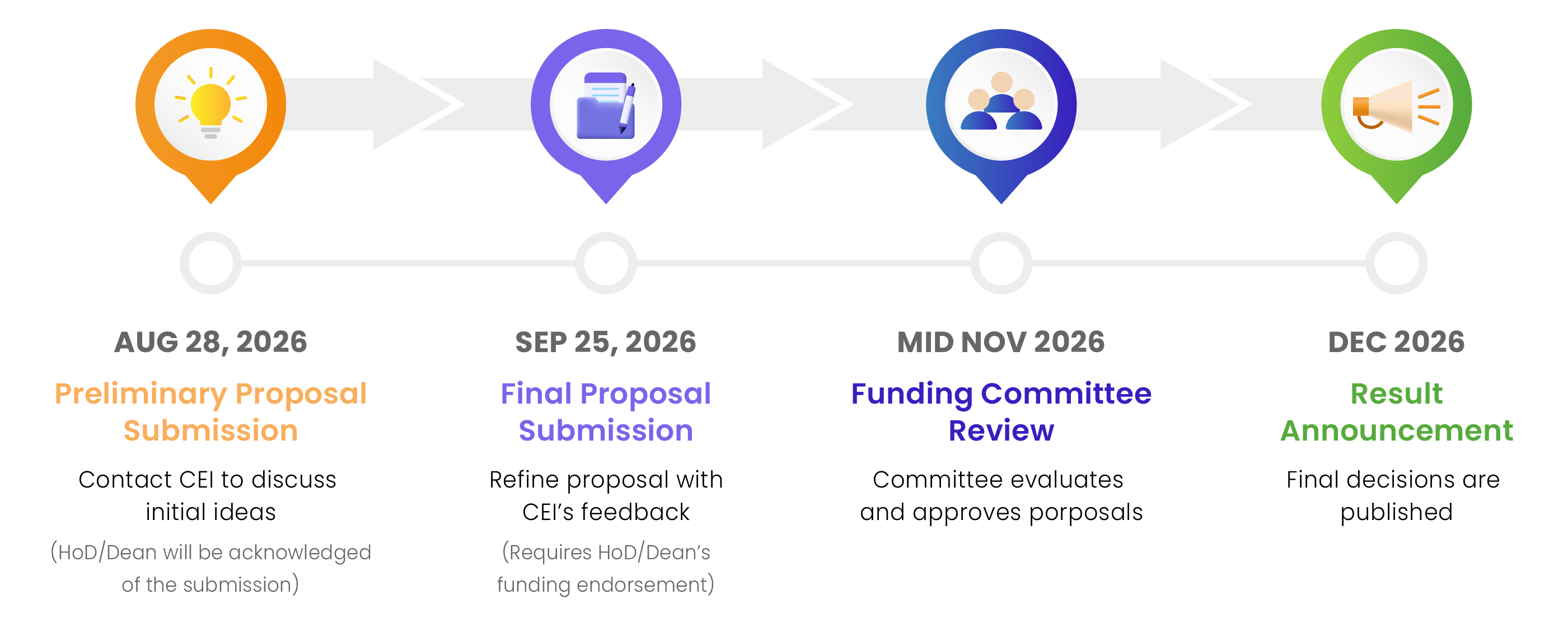
The Teaching and Learning Innovation Projects Sub-committee (TLIP) is a part of the Committee on Teaching and Learning Innovation (CTLI), chaired by the Director of the Center for Education Innovation (CEI). TLIP consists of members from PRVST, SHSS, SENG, SBM, AIS, and CEI. Its primary role is to evaluate project proposals that promote innovative pedagogies and make funding decisions.
Milestone and Key Dates
Project Reporting and Dissemination Requirements
Other than MOOC development, the project leader must:
- Disseminate project outcomes, including findings, deliverables, and experiences, through professional development within the School/Department/Division. The objective is to share with colleagues how the project deliverables can be implemented in other courses.
- Submit progress reports to CEI that describe and evaluate the implementation progress of approved projects.
- Submit a final report to CEI upon project completion. The final report must outline how the project team disseminated project outcomes and demonstrated the successful adaptation and implementation of project outcomes in two identified courses within the department.
Submission
- Preliminary proposal: Submit the preliminary proposal via CEI’s Proposal/Project Management System (PMIS) by the specified deadline. CEI will provide feedback and suggestions to help shape the proposal.
- Final proposal: PI is required to upload the CEI endorsed proposal to PMIS by specific deadline. Fund matching endorsement request will be sent to corresponding HoD/Dean via PMIS.
- Pitch your ideas: Submit a short video or slide deck with your final proposal. The presentation should cover the following:
- Pedagogical rationale, significance of pedagogical implications for adopting the proposed teaching innovation
- Content in demand by global learners (Applicable to MOOC development)
- Educational problems or opportunities being addressed
- Proposed approach and key features (including learning activities, assessment, and use of tools/technologies, where applicable)
- Target audience and number of beneficiaries
- Feasibility of the project timeline
- Implications for future teaching practices, course design, or curriculum development / Knowledge transfer of lessons learned within/across departments
- Value and expected impact on student learning
- Plans for maintaining and sustaining the developed course(s)
Policies on Copyright Clearance and Intellectual Property
- The instructor-in-charge is responsible for ensuring that all content, including images, illustrations, and multimedia elements, is cleared for copyright. Written consent from the copyright holder will be required before implementing any duplication, conversion, printing, or graphic production request.
- The University's relevant policies will govern the copyright ownership of all development carried out in the funded projects. Unless there is a written restriction against such use before the project commences, CEI may, at its discretion, use any audio, visuals, and multimedia materials from the development for university-related publications for all media.
- Please read the current Copyright Ordinance (refer to section 41A), concerning the education sector, and declare to observe the copyright regulations and take full responsibility for the use of all copyrighted materials in the project.
Application method
Application must be done by submitting proposal(s) via PMIS. Please refer to the manual below for instructions.
Download the Manual (Require HKUST login)